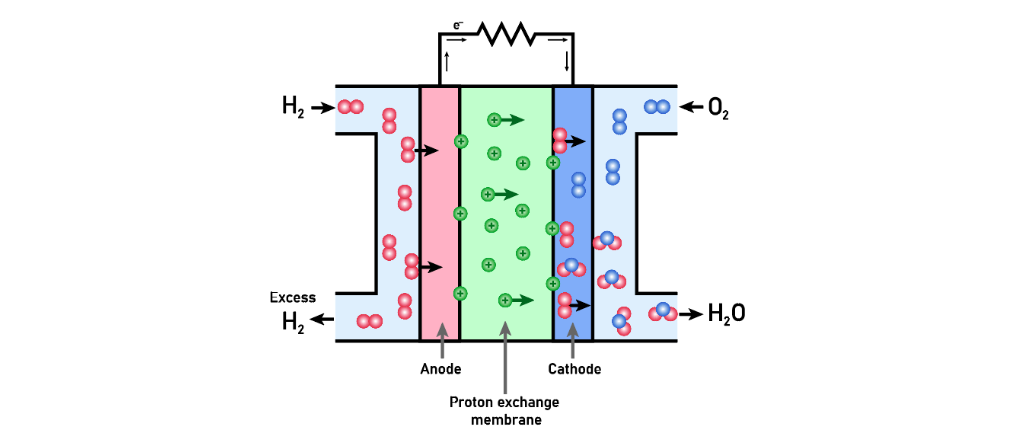

In proton exchange membrane (PEM) fuel cells, the CCM is the beating heart of energy conversion. But even the smallest manufacturing defect—such as uneven coating, material pinholes, or a foreign particle—can severely compromise efficiency, durability, or safety.
Our non-radioactive, inline QC systems empower manufacturers with real-time data, defect detection, and precision measurement catalyst-coated membranes (CCMs) and high-pressure composite-wound hydrogen tanks.
Fuel cell performance relies heavily on the consistency and integrity of its membrane layers. Any coating defect, thickness deviation, or particle contamination can compromise the electrochemical process.
During the coating process of the catalyst layers (anode and cathode), defects such as heavy edges or uneven coating at the start or end of the layer can occur. These may stem from fluctuations in viscosity, temperature, or coating speed.
→ Our solution: The L-Ray system precisely detects and tracks leading and heavy edges in real time, ensuring coatings start and end cleanly and within spec.
Uniform thickness and weight are crucial for consistent ion transport and fuel cell efficiency.
→ Our solution: The confocal L-Ray combines laser and confocal technology for precise, contactless measurement of both thickness and grammage of coated catalyst layers on membranes.
Even the smallest pinhole or foreign particle (<50 µm) can lead to electrical short circuits or local fuel crossover.
→ Our system uses optical methods to detect and classify such anomalies in real time, helping avoid costly downstream failures.
Uniformity in these ultra-thin materials affects fuel cell efficiency and durability.
→ Our integrated systems track and visualize material consistency across the entire film width.
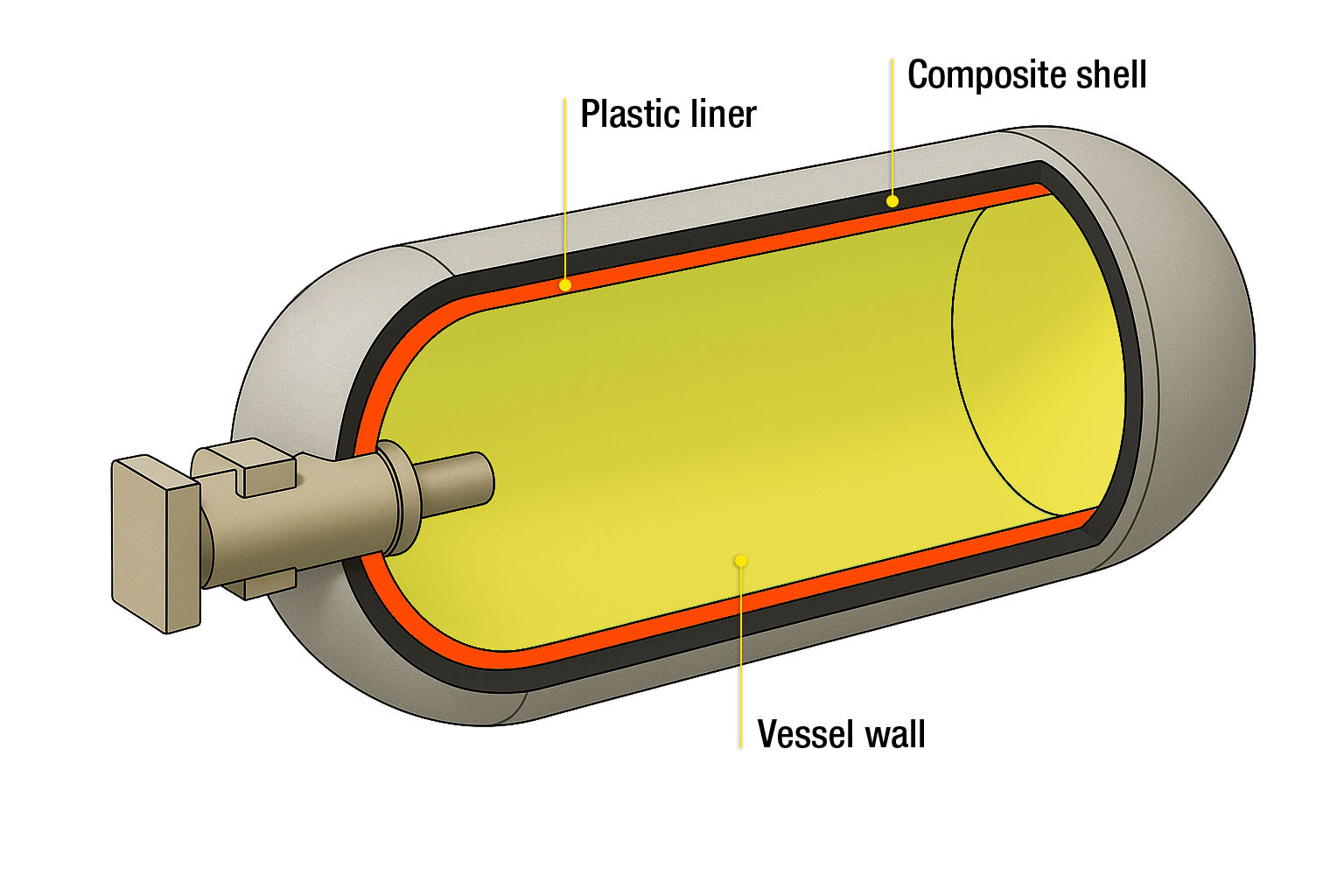
Hydrogen tanks are subjected to extremely high pressures, requiring flawless manufacturing of their composite structures and plastic liners.
The grammage (weight per unit area) of composite tape directly affects structural integrity and weight of the tank. Inconsistent grammage can create weak spots or over-engineered areas.
→ Our solution: The U-Ray platform continuously monitors the grammage of the composite material during the winding process, enabling optimal control and material efficiency.
Detecting material buildup, voids, or overlaps is key during tape application.
→ Our optical systems monitor layer uniformity and surface consistency, preventing structural faults.
The plastic liner serves as a hydrogen barrier and needs to be uniformly thick around the entire perimeter to maintain safety under pressure.
→ Our solution: The C-Ray system, based on capacitive sensing, provides non-contact thickness measurement along the full length and circumference of the liner even on curved surfaces.
Embedded particles or improper layering during tank fabrication can pose safety risks.
→ Our inspection technologies identify such issues during production to avoid downstream failure or recalls.
Fuel cell membranes and hydrogen vessels must deliver performance under extreme conditions. Even the smallest defect can lead to functional failures or serious safety issues.
Inline quality control is essential to: